10 Things Recruiters Secretly Hate Seeing on Your Resume (But Won’t Tell You)
Admin
1/28/20265 min read
Recruiters rarely give honest feedback. They won’t email you saying, “Your resume was a mess, that’s why we rejected you.” They’ll just move on.
If you’re applying on LinkedIn, Naukri, Indeed, or company portals and getting views but no interviews, there’s a good chance your resume has some of these silent killers.
Here are 10 things recruiters secretly hate seeing on your resume—and what to do instead. Use this as a checklist while building or updating your resume (especially if you’re using a template from HireLinking).
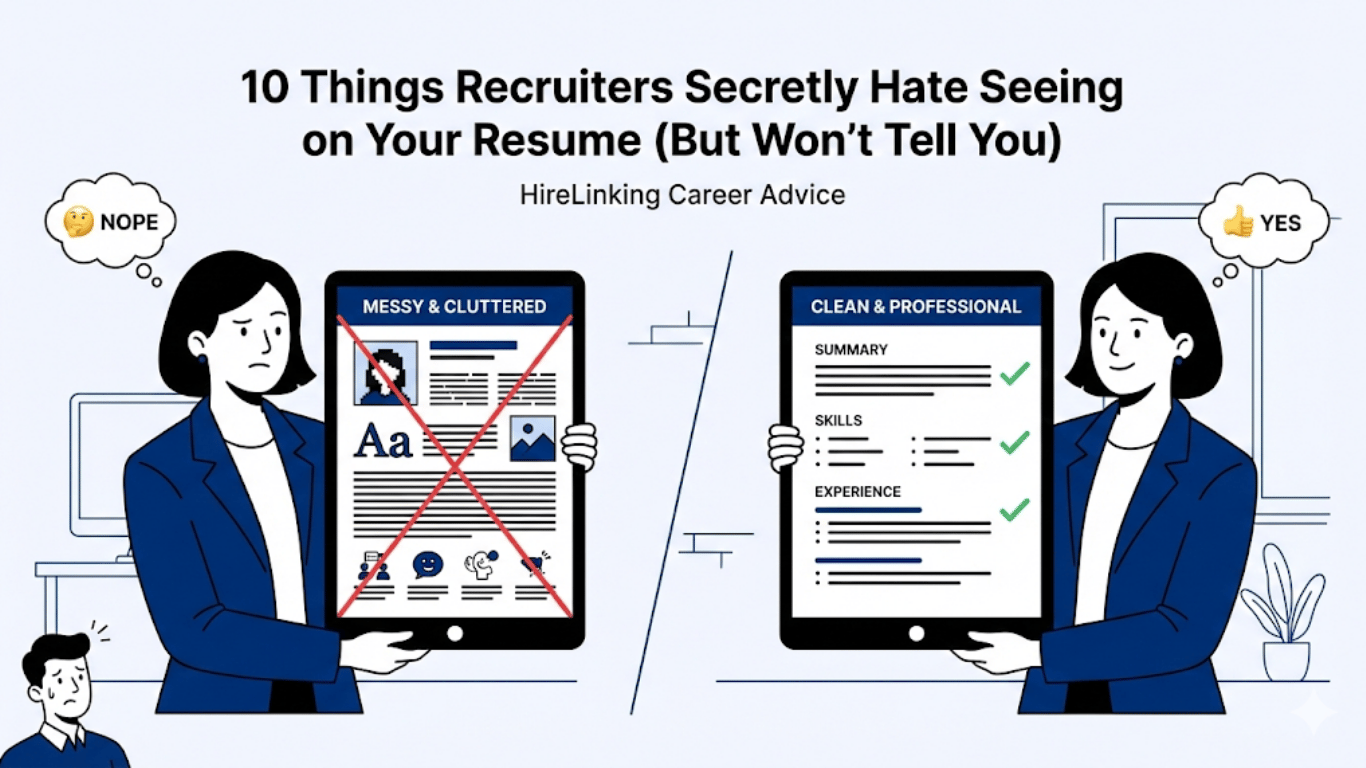
1. Overdesigned, Hard‑to‑Read CVs
Recruiters don’t want to decode your resume. They need to scan it in seconds.
What they hate:
Heavy graphics, boxes, shapes everywhere
Two or three busy columns with misaligned text
Fancy fonts that are hard to read
Text in images (ATS can’t read it, and neither can they easily)
Why it’s a problem:
It often breaks ATS parsing
Important info gets visually lost
It looks like you care more about “looking cool” than being clear
Do this instead:
Use a clean, structured template with clear headings and enough white space
Single or simple two‑column layout
Standard fonts (Arial, Calibri, Roboto, etc.)
Let content + structure do the work, design should just support it
2. Huge Paragraphs With No Bullet Points
Wall of text = recruiter nightmare.
What they hate:
Work experience written as long paragraphs with 5–7 lines each
No bullet points, no visual hierarchy
Everything looks equally important (so nothing stands out)
Why it’s a problem:
Recruiters skim—they don’t read like a novel
They can’t quickly find your top 2–3 achievements
Do this instead:
Break experience into 3–6 bullet points per role
Each bullet = Action + What you did + Result
Bold a keyword or metric occasionally (not every word)
Example:
“Increased organic website traffic by 40% in 6 months by optimizing 20+ SEO pages and building high‑intent landing pages.”
3. Responsibilities, Not Results
This is one of the biggest turn‑offs.
What they hate:
“Responsible for managing social media”
“Responsible for daily reporting”
“Worked on many projects”
Why it’s a problem:
Every candidate “managed”, “worked on”, “responsible for” something
There’s no proof of impact
Do this instead:
Turn responsibilities into achievements:
“Managed Instagram and LinkedIn content calendar; grew followers from 2,000 to 12,000 and improved average engagement rate from 1.5% to 4% in 8 months.”
“Automated daily sales reporting in Excel, reducing manual effort by 2 hours/day and improving accuracy.”
Recruiters love numbers. Even approximate improvements are better than none.
4. Buzzword Salad With No Evidence
What they hate:
“Highly motivated, passionate, result‑oriented, dynamic, hardworking, team player…”
Long lists of soft skills with zero examples
Why it’s a problem:
Everyone uses these words, so they mean nothing
Without concrete examples, it looks like filler
Do this instead:
Use soft skills where they show up in context:
“Led a 5‑member team…” → leadership, collaboration
“Coordinated between sales and operations…” → communication
One small “Strengths” line is okay, but keep it honest and short
Example:
Instead of: “Excellent communication skills”
Write: “Presented monthly performance reviews to senior management and client teams.”
5. Irrelevant or Outdated Information
What they hate:
Class 10th/12th details for someone with 5+ years’ experience
Old, unrelated jobs taking more space than your recent relevant ones
Listing every single college event from 8 years ago
Why it’s a problem:
It dilutes your main story
Wastes the limited attention your resume gets
Do this instead:
Focus 80% of your resume on the last 5–7 years (or recent relevant experience)
Remove very old or irrelevant roles, or compress them to one‑liners
For experienced profiles, education can be short; for freshers, projects/internships are more important
6. Job Titles and Dates That Look Suspicious
Recruiters are very sensitive to red flags.
What they hate:
Job titles that sound unrealistically senior for your age
Overlapping dates that don’t make sense
No dates at all
Big unexplained gaps
Why it’s a problem:
It raises doubts about honesty and stability
They worry they’ll waste time if timeline doesn’t add up
Do this instead:
Use standard, believable job titles (e.g., “Marketing Executive” instead of “Chief Growth Ninja”)
Make sure dates are correct and consistent (Month/Year – Month/Year)
If there’s a big gap, briefly mention it:
“Jan 2023 – Dec 2023: Career break to prepare for competitive exams and complete certifications in XYZ.”
A short line is better than a silent, mysterious gap.
7. Keyword Dumping in the Skills Section
What they hate:
Skills section with 25–40 items: every tool, tech, and buzzword under the sun
Listing tools you barely touched once
No indication of what you’re actually good at
Why it’s a problem:
Looks like you’re trying to game ATS, not be honest
In interviews, you’ll almost certainly be exposed
Recruiters don’t know what your core strengths are
Do this instead:
Keep skills focused and grouped:
Technical/Tools
Domain/Functional
Soft skills (very short)
Only include what you can defend confidently
Let your projects/experience prove the skills
8. Typos, Inconsistent Formatting, and Sloppy Layout
Sounds basic, but it’s a huge filter.
What they hate:
Spelling mistakes in job titles or company names
Random font changes, misaligned bullets, different bullet styles
Inconsistent date formats (e.g., “Jan 2022–Mar 23” + “2021–Present”)
Why it’s a problem:
Signals poor attention to detail
Makes them question how careful you’ll be at work
Do this instead:
Proofread once, then again later with fresh eyes
Keep one style for:
Dates
Headings
Bullets
Use a professional, pre‑aligned template (this is where HireLinking saves hours)
9. Unprofessional Contact Details and Missing Links
What they hate:
Email IDs like cuteboy123@…, princess_lover@…
No phone number or only WhatsApp number mentioned
No LinkedIn profile (for white‑collar roles)
Broken or missing portfolio/GitHub links for tech/design roles
Why it’s a problem:
First impression screams “not ready for corporate”
They can’t quickly check more about you
Do this instead:
Use a neutral, professional email:
firstname.lastname@
or a simple variation
Add:
Phone number
City + Country
LinkedIn URL
Portfolio/GitHub/Behance if relevant
10. Generic, One‑Size‑Fits‑All Resume
What they hate (but you’ll never hear directly):
A resume that could apply to any job, any company, any industry
Summary that doesn’t mention a specific role or domain
Bullets that don’t align with the job description skills
Why it’s a problem:
Shows no effort to understand the role
Makes it harder to see you as a strong specific fit
In a competitive pool, tailored resumes almost always win
Do this instead:
Keep a master resume, but create lightly tailored versions:
Adjust your headline/summary with the target role
Push the most relevant skills and projects to the top
Mirror important keywords from the job description (truthfully)
You don’t have to rewrite from scratch. Even 5–10 minutes of tuning per application can change your results.
Turn This Into an Action Checklist
Before you send your next resume, run it through this checklist:
Clean, readable layout (no design overload)
Bullets, not paragraphs
Achievements with numbers, not just duties
No buzzword salad without proof
Irrelevant old info removed or compressed
Titles and dates look realistic and consistent
Skills section is focused and honest
Formatting and spelling double‑checked
Professional email + links added
At least lightly tailored to the specific role
If you can tick these off—and you plug your content into a well‑structured resume template (like the ones on HireLinking)—you’re already ahead of most candidates.
Recruiters may not tell you what they hate.
But your inbox (and interview count) will tell you when you’ve finally stopped doing it.